

Disclaimer: The below article is for entertainment purpose only and must not be construed as scientific in nature. Although sufficient research has been done to draw conclusions, we do not claim any.
The coronavirus COVID-19 has got the entire world hooked on to it. On 11 March 2020, the Director General of the World Health Organization declared COVID-19 a global pandemic. As of 4 April, about 205 Countries and Territories around the world have reported a total of 1,203,188 confirmed cases with a death toll of 64,747 deaths. The situation is definitely unprecedented in our history when countries all together agreed to restrict borders or lockdown provinces to prevent people movement.
A world that was only moving faster with each passing day had suddenly come to a grinding halt. The prospect of a recession looming ahead doesn’t bother much. The power of the invisible COVID-19 virus is clearly visible on the face of the Earth. With the efforts to develop a vaccine seemingly far, a perfect consensual treatment is also evading the disease.
The origin of the virus is attributed to a sea food market of Wuhan. It is believed to have originated from a bat, passed on to man either through a snake or a pangolin. The market was shut down on January 1, 2020. With the pandemic spreading, Wuhan announced a lockdown on 23 January 2020 that was soon followed by other cities of the Hubei province. The Chinese lockdowns were very effective and well planned, for instance the lockdown of Wenzhou in Zhejiang province, implemented a seven-day lockdown in which only one person per household was allowed to exit once each two days. The multi-national team of the WHO and the Chinese authorities led from the front working tirelessly.
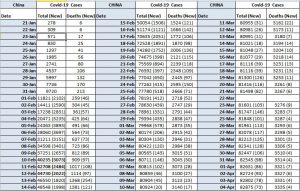
On January 11, China announced its first death from the virus, a 61-year-old man from Wuhan who had had been to the sea food market and its second death on January 17. The world had by now been alerted to the dark reality of COVID-19. The total infected in China climbed to about 83,000 with about 3340 deaths with Hubei province accounting for about 68,000 cases and 3100 deaths. However the situation in China including Hubei began stabilizing as new cases and deaths began to drop significantly from end of February and by March end the daily deaths were in single digits.
And so here we are, facing the brunt of the virus head-on, with all nations reporting newer cases and deaths each day. The situation is very bad as many nations are nowhere near the turn to witness stability in their numbers. Among the significantly affected nations are the USA, Spain, Italy, Germany, France, China, and Iran. On April 5, the US reported over 30 thousand new cases and over a thousand deaths for the second consecutive day.
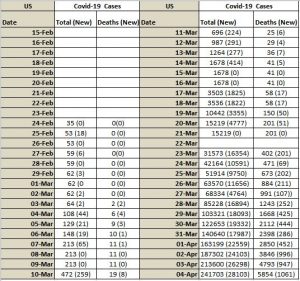
The count is only rising exponentially. However as many of these well advanced economies grapples with the pandemic, few among them are strangely dodging the virus well. The case in point is South Korea and Germany. It would be unjust to totally attribute the situation to only their policy decisions or health infrastructure. Although we know that the scientific community is way far from its vaccine goal, our understanding of the virus is itself limited. There have been no definitive conclusions on certain vital aspects of the virus.
According to China’s National Health Commission minister, Ma Xiaowei at a press meet, the incubation period could range from one to 14 days, and the virus was infectious during incubation, unlike the outbreak of severe acute respiratory syndrome (SARS). This is a very important observation that underlines its ability to dodge tests and spread rapidly.
CIDRAP (Centre for Disease and Policy) of University of Minnesota in an article titled “Studies show COVID-19 virus likely has multiple infection routes” notes that currently, testing for and confirmation of infection with COVID-19 is conducted via oral swabs. It adds that a study published in Emerging Microbes & Infections, Chinese scientists reported evidence of an oral-fecal transmission route for COVID-19 viruses and show that, in hospitalized patients, viral RNA was found in anal swabs and in blood samples.
The study was conducted in a Wuhan hospital, with samples collected from 178 patients. The study authors found viral nucleotide in anal swabs or blood even when it was not detected in oral swabs, especially in patients who had been receiving supportive care for several days.
The results of the study are the first to show COVID-19 could be transmitted via respiratory, fecal-oral, or body fluid routes, the authors say. They also warn that a patient with negative oral swabs after several days of illness may still be capable of transmitting the virus. Given our reliability only on oral swabs, here is another ability of Corono-19 to dodge tests and spread rapidly. The use of anal swabs and blood tests could be unthinkable for many nations given the scale, nonetheless they might have to sadly pay for it.
The British Medical Journal (The BMJ.com) published a study on the clinical findings among patients infected with coronavirus (SARS-Cov-2) outside of Wuhan, China. Chinese scientists looked at the clinical findings of 62 COVID-19 patients from seven hospitals in Zhejiang province, China. None of the patients died, and only one patient was admitted to the intensive care unit. The median time from exposure to onset of illness was 4 days, and from onset of symptoms to first hospital admission was 2 days.
None of the patients had exposure to the Wuhan seafood market and all had contracted the disease from another infected person. The authors said that, compared to patients in Wuhan, the patients seen in Zhejiang had relatively mild symptoms. The clinical features of cases of covid-19 in Wuhan were not the same as those in other areas of China. The study concluded that as of early February 2020, compared with patients initially infected with SARS-Cov-2 in Wuhan, the symptoms of patients in Zhejiang province are relatively mild. The conclusions reveal that cases from Wuhan were particularly very severe.
Willem van Schaik from the University of Birmingham notes that the infectious dose or the dose needed to infect is unknown for covid-19, but given how rapidly the disease is spreading, it is likely to be relatively low.
Answering the question, Does a high viral load or infectious dose make covid-19 worse? New Scientist (newscientist.com) says that emerging research indicates the relationship between infection and covid-19 severity may be more complex – and differ from that of other respiratory illnesses. The portal highlights two investigations in Lombardy and Guangzhou to drive the fact that there is no viral load difference between milder cases and severe cases. This conclusion would mean that Covid-19 is different from influenza, MERS and SARS.
But the portal also quotes another study from Nanchang, China that found a strong association between disease severity and the amount of virus present in the nose. Leo Poon of Hong Kong University, who was involved in this study opines “Those with more severe disease had a higher level of virus replication, although we have no evidence to relay the initial exposure dose to disease outcome” van Schaik sums up “Although it is difficult to draw firm conclusions at this stage, such studies may impact our assumptions about whether a high number of viral particles predisposes to a more serious disease” We don’t have a confident answer to what happens with repeated exposures particularly if Covid-19 could have multiple infection routes.
The most important takeaway from the current understanding of the scientific community is that cases with Wuhan, Hubei association are complex as also evident in the number of new cases and deaths from China. The other Chinese provinces did not see the lethality of the virus as evident in Wuhan.
The Covid-19 virus just like the ones for SARS and MERS would lose its potentiality with time. Thus we witness a cycle. The front line infections which are the deadliest pop up at the initial stages of the pandemic which would account majorly for the fatalities.
Despite the undecipherable timeline, the potentiality or propensity of any pathogen from its outbreak would always be inclined to obscurity. What matters more is at what point of the virus timeline does a given infection cycle takes off.
Imagine a situation that A infects B who infects C who then infects D, who in turn infects E. If this infection cycle occurs in a single day, then clinical assessment of A and E would be similar.

However if each of these infections occur after about 4 to 5 days and E is infected after a fortnight, E is likely to be favourably assessed compared to A. (The timeframe of 4 to 5 days is for assumption purposes only)
The front line infections at China are broadly those identifiable with any infectious contact during the early days of outbreak which may even have an association to the zero zone. Realizing that infections only at Wuhan of Hubei province are critical, China locked down Hubei. It pulled resources from other provinces and effectively halted progress of frontline infections.
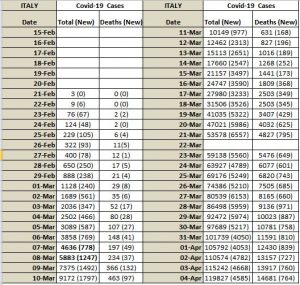
It is highly possible that the frontline infections in countries like the US, Italy, Iran, and Spain have had significant number of Wuhan returnees at the time of their respective lockdowns. With the US particularly, the early cases were largely attributed to people returning from Wuhan. The earliest cases in Europe were from France which was attributed to Wuhan returnees. When the frontline infections peak, the midline infections take off raising the number of infections further, and later stabilize the number of new infections.
The initial infections coincided with a period of lesser understanding on the need, methods, and feasibility of effective testing. After all it was for the first time in human history that such a mammoth tragedy had unfolded and if any nation had eventually done better than any other it was either sheer luck or divine grace than any human intervention.
Despite 86,000 infections, Germany has kept its fatality figures at around 1200. The first case of the new coronavirus (COVID-19) in Germany was recorded in the state of Bavaria on January 28, 2020. The individuals were among a group of around 40 people from a car parts company who had come into contact with a Chinese colleague from Shanghai who only began experiencing coronavirus symptoms on her flight back to China. So the Shanghai woman was asymptomatic even as she was transmitting. Germany is very likely to have had less or no Wuhan infections at the time of lockdown.
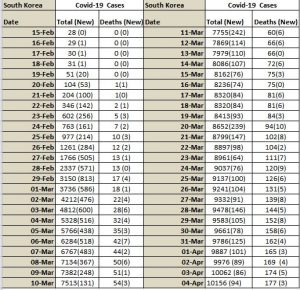
Similarly with South Korea despite its patient number 31 accounting for a significant percentage of infections, it has not seen a double digit fatality day. It needs to be mentioned here that the temperatures in Korea are slightly lesser than that in Wuhan. With over 10 thousand infections it has less than 200 fatalities.
As of now South Asia is just seeing a slow but steady rise in infection numbers. People are resting their hopes on warmer climate with the onset of summer together with some suggestions that the Asian strain of the virus is less harmful. As far as India is concerned, there are about 3577 confirmed cases with 83 deaths. The situation unfolding may be largely attributed to a large Islamic gathering, Tablighi Jamaat that took place in mid-March in Delhi.
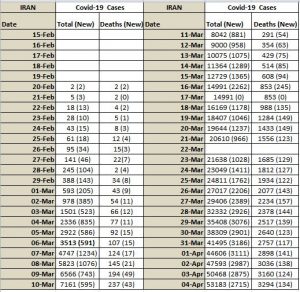
The meet was attended by foreign nationals and people from within the country, several of whom have been seen to be positive to Covid-19. Over 33 per cent of the identified cases in the country have been linked to this meet. Several of them are from Iran too. Rechecks on people who returned to India, particularly from countries where the infection is high, on dates when quarantine wasn’t implemented, could do good.
The corona has exposed our difficulty with regard to drug development during crisis. It needs to be ascertained if drug development would see favourable outcomes if it begins with a focus on rear line and midline infections rather than frontline infections; something on the lines of reverse engineering.
One phrase that many people in their respective languages say is ‘This too shall pass”. When the Corona virus ultimately slips into obscurity, everything too would gradually go into history. Together we shall then work on possible ways to reduce such deadly outcomes in future. With rats, bats, mosquitoes, birds etc. viruses shall always emerge.


